Greater Manchester Voting Change Ignites Labour–Reform Row Ahead of Crucial Mayoral Election
A major political dispute has erupted over changes to the voting system for the Greater Manchester mayoral election, with critics claiming that the return of second-preference voting could make it significantly harder for Reform UK to capture one of Labour’s most important regional strongholds.
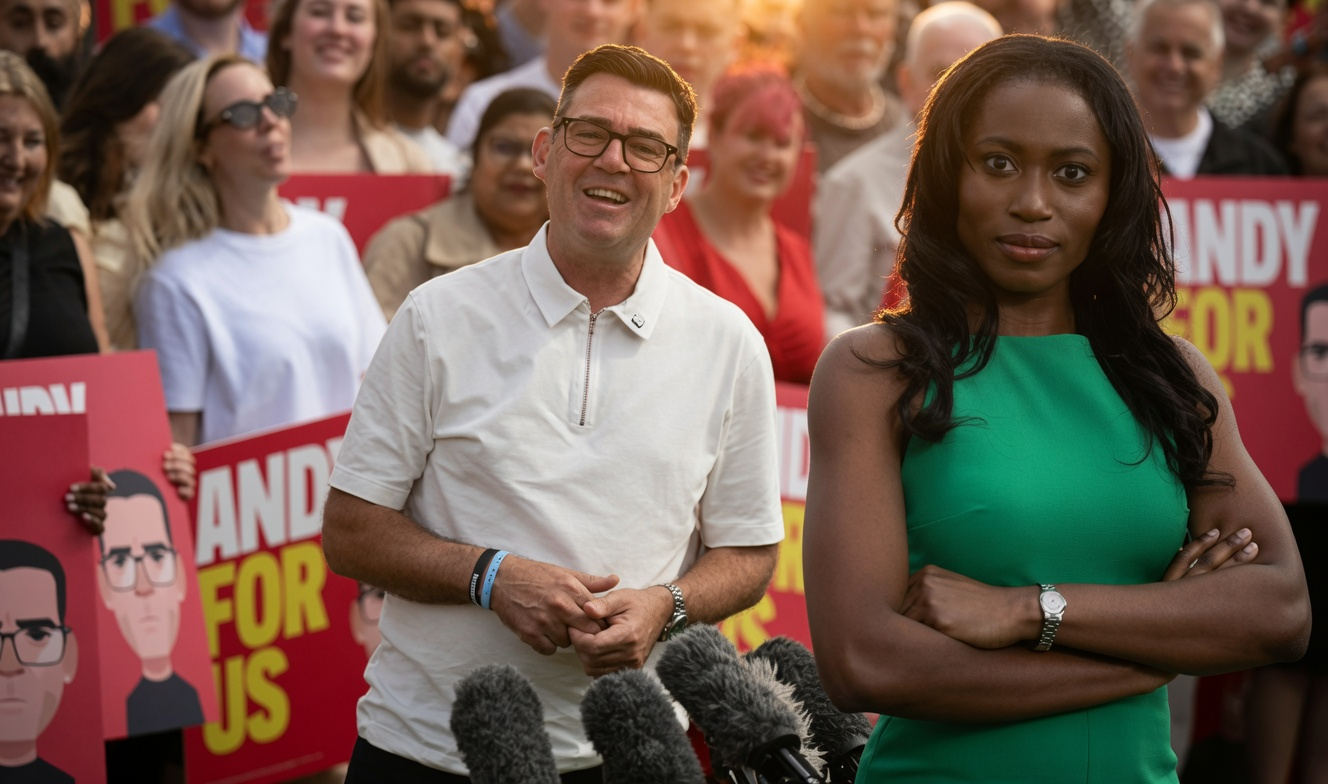
The election, scheduled for 30 July 2026, was triggered after Andy Burnham left his position as Mayor of Greater Manchester following his return to Parliament. Burnham has since become Labour leader and is expected to be formally invited by the King to form a government.
Until that constitutional process is complete, however, Sir Keir Starmer remains Prime Minister. That technical distinction may appear minor, but it matters at a moment when Burnham is attempting to convince the country that his leadership will represent a cleaner and more confident style of politics.
Instead, one of the first controversies surrounding his rise concerns the rules under which Greater Manchester residents will choose his successor.
A costly election at a sensitive moment
Replacing Burnham will require an unexpected regional election likely to cost taxpayers several million pounds. Previous Greater Manchester mayoral contests have carried multimillion-pound price tags, adding to questions about the political and financial consequences of Burnham’s move back to Westminster.
For many voters, the frustration is understandable. They elected Burnham as mayor in 2024 and reasonably expected him to complete his term. Instead, they are now being asked to return to the polling stations because national political events have overtaken the mandate they previously gave him.
There is nothing unlawful about a politician pursuing a different office. Ambition is part of political life, and Burnham’s supporters believe he can bring the experience of Greater Manchester to Downing Street.
Nevertheless, there is an emotional cost when voters feel that their area has become a stepping stone in someone else’s career. A new ballot may be constitutionally necessary, but it is difficult to blame residents for wondering whether their original choice has been treated with sufficient respect.
What has changed?
The 2024 Greater Manchester mayoral election was conducted using First Past the Post. Under that system, voters selected one candidate, and the person receiving the largest number of votes won—even without majority support.
The July 2026 election will instead use the Supplementary Vote system, which was previously used for Greater Manchester mayoral elections in 2017 and 2021.
Voters will be able to select both a first-choice and an optional second-choice candidate. Should one candidate receive more than 50 per cent of first-choice votes, that person will win immediately.
Otherwise, only the two leading candidates will remain in the contest. Candidates finishing below the top two will be eliminated, and eligible second preferences from their supporters will then be transferred to one of the two finalists. The candidate with the highest combined total will become mayor.
Supporters of the system argue that it gives voters greater freedom and ensures that the winning mayor commands support beyond a narrow section of the electorate.
Critics see something more politically convenient.
Why Reform UK is concerned
Under First Past the Post, a fragmented field can allow a candidate to win with a relatively modest share of the vote. If Labour, the Greens and other progressive parties compete separately, Reform UK could theoretically finish first even when most voters collectively support parties on the political left or centre-left.
Supplementary Vote changes that calculation.
A Green or Liberal Democrat supporter, for example, could select their preferred party as a first choice while placing Labour second. Should their original candidate be eliminated, that second preference could help the Labour candidate defeat Reform in the final count.
Reform supporters consequently believe that the new system encourages rival parties to combine against them without entering a formal electoral alliance.
That does not mean Labour is guaranteed victory. Second preferences belong to individual voters, not political parties, and nobody can order the public to transfer their support in a particular direction. Reform could also attract second-choice votes from Conservative supporters or others dissatisfied with Labour.
Even so, the political advantage is easy to understand. Labour has a stronger chance of collecting preferences from voters whose first loyalty lies with another progressive party, while Reform remains more isolated from potential transfer partners.
For a party hoping to deliver a symbolic breakthrough in one of England’s most important city regions, that presents a serious obstacle.
Was the system introduced specifically to stop Reform?
This is where the accusation requires careful examination.
The voting change was not personally ordered by Andy Burnham, nor was it written exclusively for the Greater Manchester election.
Labour’s government had already committed itself to restoring Supplementary Vote for mayoral and police and crime commissioner elections across England. The English Devolution and Community Empowerment Act received Royal Assent on 29 April 2026, formally reversing the move to First Past the Post introduced under the Elections Act 2022.
The government argues that directly elected mayors exercise substantial executive power and should therefore demonstrate broader support among voters. Supplementary Vote, ministers say, makes it less likely that a mayor will be elected with only a small percentage of the overall vote.
That is a legitimate democratic argument. It is also worth remembering that Supplementary Vote is not a new invention created for Labour’s present difficulties. Greater Manchester residents used it in the first two mayoral elections before First Past the Post was introduced.
Nevertheless, timing matters in politics almost as much as intention.
In May, ministers openly acknowledged that a Greater Manchester election might become necessary if Burnham won his parliamentary contest. The government then moved to ensure that the regulations required for Supplementary Vote would be in force in time.
The nationwide legislation may have existed independently of Burnham’s personal ambitions, but its accelerated application to this particular election inevitably created suspicion.
That suspicion becomes stronger when the governing party appears likely to benefit from the change.
Labour faces a question of trust
The fundamental issue is not whether Supplementary Vote is inherently democratic or undemocratic. Both systems are used in established democracies, and each produces different incentives, advantages and weaknesses.
The deeper issue is public confidence.
Election rules should be stable, understandable and applied consistently. Whenever a government changes those rules shortly before a politically important contest, it carries a heavy responsibility to demonstrate that the decision was based on principle rather than partisan calculation.
Labour can reasonably argue that it is restoring the system used before 2023 and creating a mayor with broader electoral backing. Reform can equally point out that the change may make it harder for an insurgent party to convert a divided opposition into victory.
Both statements can be true at the same time.
That uncomfortable reality is often missing from the shouting match surrounding electoral reform. Political parties frequently defend whichever voting system appears most favourable to them at a particular moment. Principles suddenly become flexible when power is within reach.
Conservatives replaced Supplementary Vote with First Past the Post. Labour has now reversed that decision. Each side has presented its preferred system as the more democratic option, yet neither can entirely escape the suspicion of political self-interest.
For voters already exhausted by leadership contests, resignations and tactical manoeuvring, the result is another layer of cynicism.
Reform’s divided campaign
The Greater Manchester dispute comes as Reform UK faces strategic pressure elsewhere. Party activists have reportedly been encouraged to focus greater attention on Clacton, where Nigel Farage is fighting another parliamentary by-election after resigning his seat and seeking a renewed mandate.
Moving campaign resources away from Manchester could weaken Reform’s ability to compete in a vast and politically diverse region containing ten metropolitan boroughs.
That decision cannot be blamed on the voting system alone. It reflects the limitations faced by a growing party attempting to fight several high-profile contests simultaneously.
Nevertheless, Reform will argue that it is being forced to compete on political terrain redesigned by the government at precisely the moment when it appeared capable of threatening Labour.
Whether voters accept that argument may be as important as the final calculation of first and second preferences.
Burnham’s first democratic test
Andy Burnham has built much of his political identity around regional pride, plain speaking and the belief that Westminster should listen more closely to communities outside London.
Greater Manchester was central to that reputation. It gave him a platform, a national profile and eventually a route back into Parliament.
That history creates a personal obligation.
As he prepares to enter Downing Street, Burnham must show that the people who helped build his career are not merely being managed as part of a national political strategy. He should welcome scrutiny of the voting change rather than dismiss every concern as partisan hostility.
The strongest response would not be to claim that the system is beyond criticism. It would be to explain clearly why it was restored, why it is being introduced now and why the same principle will be applied consistently in future elections—even when it disadvantages Labour.
Democracy is not protected simply because an election follows the law. It also depends upon voters believing that the law has not been shaped to predetermine their choice.
Supplementary Vote may produce a mayor with broader support. It may also prevent Reform from benefiting from a divided field. The election result alone will not prove that the system was fair or unfair.
What matters is whether every candidate is allowed to compete openly, whether voters understand how their preferences will be counted and whether the government can demonstrate that the rules were designed for the public—not for the survival of one political party.
Burnham has promised a new kind of politics. Greater Manchester will provide one of the earliest and most revealing tests of whether that promise extends to the rules of the democratic game.