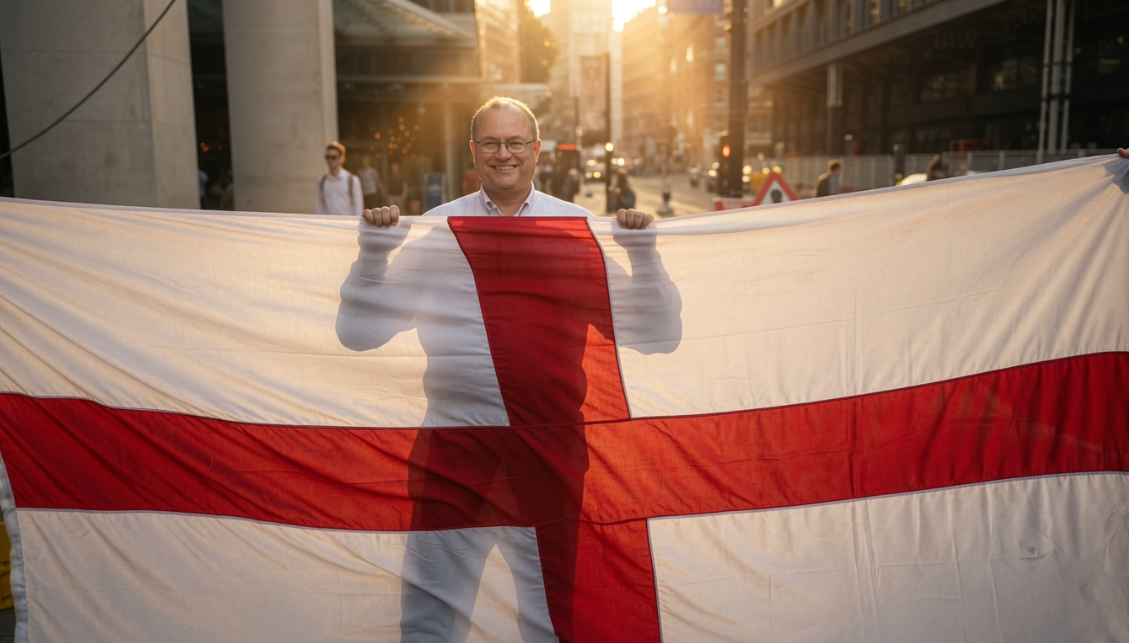
Westminster Council Flies St George’s Flag as Debate Over Patriotism and Public Spaces Intensifies
Westminster City Council leader Paul Swaddle has encouraged residents and organisations to display England’s flag ahead of the national team’s quarter-final against Norway, placing the capital at the centre of a wider debate about patriotism, civic pride and the use of public property.
Westminster City Hall has raised the St George’s Cross as England prepares for a highly anticipated football match against Norway, with council leader Paul Swaddle calling on people across the borough to show their support for the national team.
The decision may appear straightforward during a major sporting tournament, but it comes at a time when the display of national flags has become an unexpectedly sensitive political issue in parts of the country.
For many football supporters, seeing the red-and-white cross hanging from homes, shops and public buildings is simply part of the shared excitement surrounding an England match. It represents anticipation, belonging and the hope that, perhaps this time, the national team can produce another memorable chapter.
Councillor Swaddle said he wanted Westminster to embrace that atmosphere.
“I’ve ensured that our building is flying the St George flag as England prepare for their titanic quarter-final clash with Norway,” he said.
“We’re proud to fly the flag and get behind the Three Lions. Good luck to Harry, Jude and the rest of the boys. It would be great to see as many people as possible across Westminster flying the St George’s Cross.”
His message is deliberately upbeat. Rather than treating the flag as a source of controversy, Westminster’s Conservative leadership has presented it as a positive symbol around which residents can gather during a major national event.
A simple gesture carrying a wider meaning
Sport has always had the ability to bring together people who may otherwise have little in common. During a major tournament, strangers discuss team selections on buses, children wear replica shirts to school and communities gather around television screens in pubs, living rooms and public venues.
For a brief period, political disagreements and everyday frustrations can fade into the background.
That is why the sight of the St George’s Cross can feel deeply personal to many supporters. It may remind them of watching matches with parents or grandparents, celebrating famous victories with friends or experiencing the nervous silence that falls across a room before a crucial penalty.
This emotional connection should not automatically be confused with hostility towards other countries or cultures. Healthy patriotism does not require people to believe their nation is superior. It can simply mean feeling affection for the place one calls home and wanting its representatives to succeed.
However, disagreements have emerged over where national flags should be displayed and whether individuals should be allowed to attach them to publicly owned infrastructure without permission.
Oxfordshire dispute raises questions about council control
The issue has received attention following legal action involving Oxfordshire County Council and unauthorised flags placed on lamp posts.
Council leader Tim Bearder defended an injunction intended to prevent people from attaching flags or other items to council-owned street furniture without approval.
Following the legal decision, he said: “We’ve secured the first ever injunction of its kind in the country, and this will serve as a blueprint for other councils wishing to stop this irresponsible behaviour.”
Supporters of the council’s position argue that local authorities have a responsibility to manage public infrastructure consistently. Lamp posts, road signs and other street fixtures must be maintained safely, and councils may be concerned about damage, visibility, road safety or the precedent created when items are installed without consent.
From that perspective, the dispute is not necessarily about opposition to the English flag itself. It concerns who has the authority to use public property and under what conditions.
Critics, however, believe the council’s response was disproportionate, particularly during a football tournament when national flags are commonly displayed across the country.
They question whether legal proceedings were the most sensible use of council resources and argue that authorities could have found a more flexible solution, such as creating approved locations or issuing clear temporary guidance.
That criticism reflects a wider frustration felt by residents in many areas. When people are worried about potholes, social care, housing, waste collection and stretched local services, expensive or highly visible disputes over flags can appear detached from their daily priorities.
Even when a council has legitimate legal or safety concerns, public confidence can be damaged if its response seems heavy-handed.
Critics accuse councils of discouraging national pride
Conservative Party chairman Kevin Hollinrake criticised Oxfordshire County Council’s approach and urged public bodies to be more comfortable with national symbols.
“We should be unashamedly proud of our national identity,” he said. “The Union Jack and the Flag of St George both unite our nation.”
“People should be encouraged to show their patriotism, not lectured out of it.”
Former football manager Harry Redknapp also offered a characteristically direct response.
“Fly your flags, be proud of your country. Don’t be ashamed,” he said.
Their comments will resonate with supporters who believe institutions have become overly cautious about displays of English identity.
Some people feel that the St George’s Cross has occasionally been treated with suspicion because it has, at times, been adopted by political groups promoting divisive messages. Yet allowing any extremist minority to claim ownership of a national symbol risks pushing ordinary citizens away from something that should belong to everyone.
A flag does not have one permanent political meaning. Its significance depends on how it is used and the message accompanying it.
When families display the St George’s Cross during a football tournament, they are usually expressing support for a team rather than making a statement about immigration, party politics or cultural exclusion.
Consistency remains essential
The debate has also raised questions about whether councils apply flag-related rules consistently.
Reports have highlighted that former Liberal Democrat MEP Catherine Bearder, Tim Bearder’s mother, previously objected when she was asked to remove a European Union flag displayed outside her home.
She reportedly argued that the council should concentrate on more important matters rather than policing flags.
The circumstances may not be identical, particularly if one case involved private property and another involved council-owned street furniture. Nevertheless, the comparison has contributed to accusations of inconsistency.
Public authorities must be able to explain their rules clearly and apply them impartially. Residents are far more likely to accept restrictions when they understand the practical reasons behind them and believe that different political or national symbols are being treated according to the same standards.
Without that transparency, even routine enforcement can begin to look ideological.
Patriotism should be inclusive, not confrontational
The most constructive response may lie between unrestricted use of public property and an outright hostility towards national displays.
Councils are entitled to protect their infrastructure and ensure public safety. At the same time, they should recognise the cultural importance of major sporting occasions and the positive role that shared celebration can play within communities.
Temporary flag displays could be managed through designated areas, time-limited permissions or simple guidance explaining what residents may and may not do.
Such an approach would preserve public order without making people feel that their national identity is being treated as embarrassing or unwelcome.
Patriotism is healthiest when it is confident enough to be generous. Supporting England should not require disrespecting Norway or anyone else. Flying the St George’s Cross should be an invitation to join a celebration, not a test of who belongs.
That distinction matters in a diverse country where millions of people have different family histories but still feel emotionally invested in England’s national team.
Westminster chooses celebration
By raising the flag over City Hall, Westminster Council has chosen to focus on the communal side of the occasion.
The gesture will not resolve the national argument over flags, public property and political symbolism. It does, however, demonstrate that local government can participate in moments of collective excitement without turning them into a confrontation.
There is something reassuringly human about that decision.
Public life is often dominated by budgets, regulations, complaints and political disputes. Allowing a council building to reflect the anticipation felt by millions of supporters is a reminder that institutions also belong to the communities they serve.
Whether England wins or loses, the flag flying above Westminster represents a moment of shared hope.
For supporters, that hope is not complicated. It is the familiar feeling that arrives before a major match: the nervous conversations, the imagined possibilities and the belief that the players wearing the Three Lions might deliver a night the country remembers for years.
On this occasion, Westminster has decided to embrace that feeling — proudly, publicly and without apology.